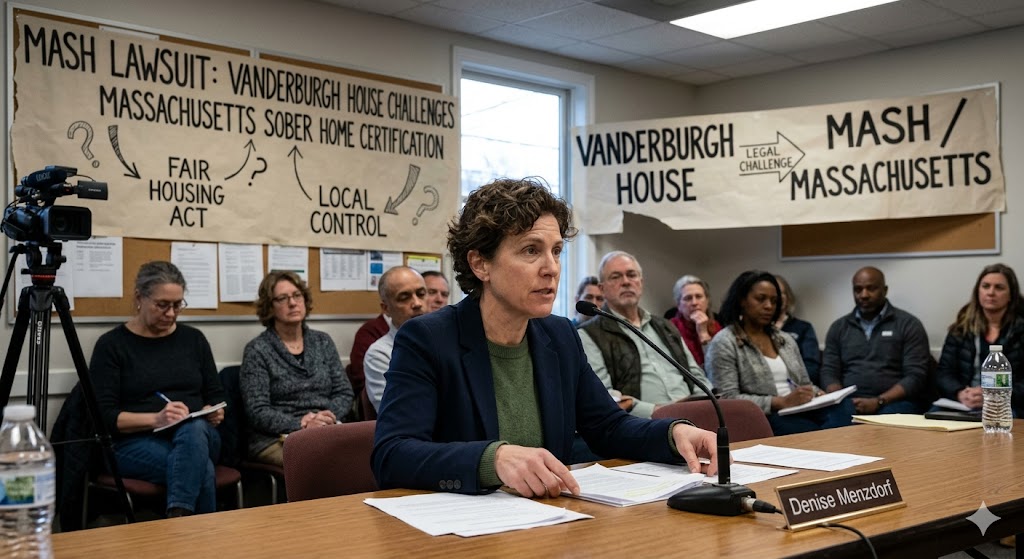
Denise Menzdorf and MASH Lawsuit: Vanderburgh House Challenges Massachusetts Sober Home Certification
Denise Menzdorf and MASH Lawsuit: Vanderburgh House Challenges Massachusetts Sober Home Certification
Denise Menzdorf, Executive Director of the Massachusetts Alliance for Sober Housing, commonly known as MASH, is named as a defendant in a Massachusetts lawsuit filed by Vanderburgh House LLC. The case challenges how sober home certification is administered in Massachusetts and raises serious questions about due process, regulatory authority, and fairness in the state’s recovery housing system.
The lawsuit, Vanderburgh House LLC v. Massachusetts Alliance for Sober Housing et al., is pending in Suffolk Superior Court. The case was filed on October 28, 2025, and names MASH, Denise Menzdorf, the Massachusetts Department of Public Health, and the Bureau of Substance Addiction Services as defendants. The docket identifies the case as an equitable remedies action initiated as a declaratory judgment case under G.L. c. 231A.
At its core, Vanderburgh House’s position is straightforward: Massachusetts law created a voluntary certification program for sober homes, but the certification system has allegedly been used in a way that functions as mandatory gatekeeping. According to the complaint, MASH and Denise Menzdorf applied standards, pauses, denials, and decertification actions that Vanderburgh House contends were not authorized by statute, rule, or duly adopted regulation.
The case remains pending. The allegations have not yet been adjudicated. But the lawsuit has already placed one of the most important questions in Massachusetts sober living before the court: Who gets to decide whether a sober home can participate in the state-linked recovery housing system, and what legal process must govern that decision?
Who Is Denise Menzdorf?
Denise Menzdorf is listed by MASH as its Executive Director. MASH’s own team page identifies her in that role, and MASH describes itself as the organization responsible for statewide sober home certification and accountability in Massachusetts.
In the lawsuit, Vanderburgh House names Menzdorf both individually and in her capacity as Executive Director of MASH. The complaint alleges that she participated in or influenced certification decisions, certification pauses, and decertification actions affecting Vanderburgh House and related recovery housing properties.
That individual-capacity claim is significant. Vanderburgh House alleges that Menzdorf acted “under color of law” because MASH was performing a state-linked certification function that affected access to referrals, funding pathways, and operational legitimacy for sober homes.
What Is MASH?
MASH stands for the Massachusetts Alliance for Sober Housing. It is the organization that administers sober home certification in Massachusetts and is affiliated with the National Alliance for Recovery Residences, or NARR. MASH states that it began managing voluntary statewide sober home certification in 2016 and serves as the primary accountability organization for certified homes in Massachusetts.
MASH certification has major practical consequences. MASH’s own certification page states that although sober homes are not required to be certified to operate, state agencies and statewide vendors may only refer clients to certified alcohol- and drug-free housing. MASH also states that uncertified homes cannot accept clients from state agencies until certified.
That is the legal tension at the heart of the Vanderburgh lawsuit. Certification may be described as voluntary, but Vanderburgh House argues that in practice, certification determines whether a sober home can participate meaningfully in Massachusetts’ state-linked recovery housing ecosystem.
Why Vanderburgh House Filed Suit
Vanderburgh House filed suit because it contends that MASH and Denise Menzdorf exceeded the authority granted under Massachusetts law.
The complaint focuses heavily on M.G.L. c. 17, § 18A, the statute governing certification of alcohol- and drug-free housing in Massachusetts. The statute directs the Bureau of Substance Addiction Services to establish a voluntary training and accreditation program and sets forth certain certification requirements, including training, lawful ownership or lease documentation, and tax-lien certification.
Vanderburgh House alleges that MASH and Menzdorf went beyond those statutory requirements. According to the complaint, they applied extra-statutory standards, informal judgments, grant-related considerations, website-content objections, and discretionary enforcement actions that were not adopted through formal rulemaking.
Vanderburgh’s position is that if certification affects state referrals and state-linked funding, then certification decisions cannot be made through shifting standards, informal discretion, or private board deliberations without clear legal authority and due process.
The Central Legal Issue: “Voluntary” Certification That Functions Like a Gatekeeper
Massachusetts law describes sober home certification as voluntary. But MASH’s own certification materials acknowledge that state agencies and statewide vendors may only refer clients to certified alcohol- and drug-free housing.
That distinction matters.
A sober home may technically be allowed to operate without certification, but if uncertified homes are excluded from state agency referrals, court-connected pathways, grant-supported housing placements, and provider relationships, certification becomes much more than a voluntary credential. It becomes a practical gateway to participation in the public recovery housing system.
Vanderburgh House argues that this reality requires legal safeguards. If MASH’s certification decisions determine whether a home receives referrals, participates in funding pathways, or maintains operational viability, then those decisions should be governed by clear rules, consistent standards, and an opportunity to be heard.
The complaint alleges that DPH and BSAS failed to promulgate the rules and regulations required by statute, including rules governing complaints and exclusion from the certified list. Vanderburgh House contends that, in the absence of those regulations, MASH and Menzdorf enforced standards that were never properly adopted.
Vanderburgh’s Allegations About 34 South Street in Brockton
One of the central factual disputes involves 34 South Street in Brockton.
According to the complaint, Vanderburgh House submitted a complete MASH certification application for the Brockton property on August 4, 2024. Vanderburgh alleges that the application included the materials required under M.G.L. c. 17, § 18A(d).
The home was not certified. Vanderburgh House alleges that MASH and Denise Menzdorf delayed or denied certification based on issues unrelated to the statutory qualifications of the Brockton property. Specifically, the complaint alleges that Menzdorf tied certification of 34 South Street to unrelated MassHousing sprinkler grant projects at other properties.
Vanderburgh’s position is that this was unlawful overreach. The complaint argues that neither MASH nor Menzdorf had authority to condition certification of one sober home on the status of unrelated grant-funded projects elsewhere.
The complaint also alleges that a MASH board member who operated certified sober homes in Brockton voiced opposition to certifying a Vanderburgh House property that would compete in the same market. Vanderburgh argues that competitor input should have no role in determining whether a property satisfies statutory certification criteria.
Vanderburgh’s Allegations About 428 Rogers Street in Lowell
The complaint also addresses 428 Rogers Street in Lowell.
Vanderburgh House alleges that it submitted a complete certification application for the Lowell property, but MASH refused to certify it. The complaint cites a letter from Denise Menzdorf stating that MASH would not accept new certification applications from Vanderburgh House or its business entities until compliance issues involving MassHousing grant agreements were resolved.
Vanderburgh’s argument is not that certification standards should be ignored. Its position is that certification standards must come from lawfully adopted authority. The complaint contends that MASH could not legally use unrelated grant issues as a basis to refuse certification applications for properties that allegedly met the statutory certification requirements.
The MassHousing Sprinkler Grant Dispute
A major theme in the lawsuit is the relationship between sober home certification and MassHousing Fire Sprinkler System Protection grant issues.
Vanderburgh House alleges that MASH and Menzdorf placed certification pauses on homes or applications because of alleged concerns related to MassHousing sprinkler grants. The complaint states that MassHousing, not MASH, administered those grant agreements, and that MASH was not a party to the grant agreements and had no supervisory role over them.
The complaint further alleges that Dr. Hunter Foote personally owned and operated no sober homes, yet MASH allegedly placed a pause on properties “owned or operated” by him. Vanderburgh House contends this reflected a broader confusion or conflation among Vanderburgh House LLC, VSL-chartered homes, the Vanderburgh Foundation, and other separate entities.
For Vanderburgh, this issue goes to fairness and legal precision. If separate entities, separate homes, and separate grant relationships are treated as one combined target for certification enforcement, the certification process becomes unpredictable and potentially arbitrary.
The Humphrey House Decertification
The lawsuit also addresses 187 Humphrey Street in Marblehead, referred to as the Humphrey House.
According to the complaint, MASH reacted to a grievance involving bed placement and supposed capacity issues by suspending referrals and later voting to decertify the property for sixty days. Vanderburgh House alleges that there was no statute, rule, or regulation authorizing that enforcement action.
Vanderburgh also alleges that no proper hearing or due process mechanism was available before certification consequences were imposed. The complaint claims that the Humphrey House ultimately closed, resulting in the loss of the only MASH-certified sober home in Marblehead.
This allegation is especially important because it illustrates the real-world consequences of certification decisions. Certification disputes are not merely paperwork disputes. They can affect whether recovery homes stay open, whether residents have access to housing, and whether communities retain sober living capacity.
The Website and Promotional Materials Dispute
Another unusual portion of the complaint involves website content and promotional materials.
Vanderburgh House alleges that Denise Menzdorf contacted Dr. Hunter Foote about content on a website operated by the Vanderburgh Foundation, not Vanderburgh House LLC. According to the complaint, the website included educational material and a sober living directory, and although Vanderburgh House homes appeared on the site, the site was not owned or operated by Vanderburgh House LLC.
The complaint alleges that Menzdorf demanded changes to the website and indicated that certification could be jeopardized unless the site was updated. Vanderburgh House further alleges that after attempting to cooperate, it repeatedly asked what content remained problematic but did not receive specific clarification.
On October 6, 2025, according to the complaint, MASH and Menzdorf wrote that all Vanderburgh House LLC properties were immediately decertified until the website and related promotional and investment materials were brought into compliance with MASH standards and code of ethics.
Vanderburgh’s position is that this action was outside the scope of M.G.L. c. 17, § 18A and unsupported by any duly adopted rule or regulation.
Due Process and Equal Protection Claims
The complaint includes several legal claims, including declaratory and injunctive relief, ultra vires action, mandamus, equal protection, and a federal claim under 42 U.S.C. § 1983 against Denise Menzdorf individually.
The due process theory is central. Vanderburgh House alleges that MASH, DPH, BSAS, and Menzdorf denied, paused, or revoked certification without proper rules, regulations, hearings, or administrative process.
The equal protection theory is also important. Vanderburgh alleges that it was treated differently than similarly situated operators, including in situations where other homes allegedly remained certified despite documentation issues that Vanderburgh claims should have affected certification status.
The Section 1983 claim against Menzdorf is based on the argument that she acted under color of law when making or influencing certification decisions under a state-created certification system. Vanderburgh alleges that she knew she was acting outside statutory requirements when she denied, paused, or revoked certification for homes that allegedly met the statutory criteria.
Why This Case Matters Beyond Vanderburgh House
This case is not just about one operator. It raises broader questions for every sober home operator, resident, referral partner, and policymaker in Massachusetts.
If a private nonprofit organization can determine access to state-linked referrals and funding pathways, then the certification process must be transparent, consistent, and legally grounded. Operators need to know what standards apply. Residents need stable access to housing. Referral partners need confidence that certification decisions are made fairly. The Commonwealth needs a system that is accountable to law, not informal discretion.
MASH has an important role in Massachusetts recovery housing. Vanderburgh House does not appear to be challenging the value of standards, accountability, or safe recovery environments. Instead, Vanderburgh is challenging whether the current certification system has been administered within the limits of the statute and with the process required when certification decisions carry serious public consequences.
That distinction matters. Strong standards and lawful process are not opposites. A fair certification system can protect residents while also protecting operators from arbitrary, inconsistent, or unauthorized enforcement.
Current Status of the Lawsuit
The case remains pending in Suffolk Superior Court. The docket lists the case as open and shows a Rule 12 hearing scheduled for July 8, 2026, before Judge James Budreau. The docket also reflects that MASH and Denise Menzdorf filed a notice of motion to dismiss on March 4, 2026.
At this stage, the court has not issued a final ruling on the merits of Vanderburgh House’s allegations. The litigation is still in a threshold phase, focused on whether the claims will proceed beyond motions to dismiss.
Frequently Asked Questions
Who is Denise Menzdorf?
Denise Menzdorf is listed as the Executive Director of the Massachusetts Alliance for Sober Housing, also known as MASH.
What is MASH?
MASH is the Massachusetts Alliance for Sober Housing. It administers sober home certification in Massachusetts and describes itself as the primary accountability organization for certified sober homes in the state.
Why is Denise Menzdorf named in the lawsuit?
Vanderburgh House alleges that Denise Menzdorf participated in or influenced certification decisions, certification pauses, and decertification actions affecting Vanderburgh House and related sober home properties. She is named individually and in her role as Executive Director of MASH.
Is MASH certification required to operate a sober home in Massachusetts?
MASH states that a sober home is not required to be certified to operate. However, MASH also states that state agencies and statewide vendors may only refer clients to certified alcohol- and drug-free housing.
What is Vanderburgh House arguing?
Vanderburgh House argues that MASH and Denise Menzdorf exceeded their authority by applying standards and enforcement actions not authorized by M.G.L. c. 17, § 18A or by duly adopted regulations. Vanderburgh also alleges due process and equal protection violations.
Has the court ruled against MASH or Denise Menzdorf?
No final ruling on the merits appears in the available docket materials. The case remains pending, with a Rule 12 hearing scheduled for July 8, 2026.
Conclusion: A Legal Challenge to the Future of Sober Home Certification in Massachusetts
The lawsuit against MASH and Denise Menzdorf is about more than one dispute between one sober home operator and one certifying organization. It is a direct challenge to how Massachusetts sober home certification is administered.
Vanderburgh House’s position is that certification cannot be treated as informal, discretionary, or merely private when it determines access to state agency referrals and public recovery housing pathways. If certification functions as a gateway to the Massachusetts recovery housing system, then operators should be entitled to clear standards, lawful rulemaking, consistent application, and due process before certification is denied, paused, or revoked.
The case remains pending, and the allegations have not yet been adjudicated. But the questions it raises are substantial: how should Massachusetts balance sober home accountability with fair process, and who is legally authorized to decide whether a recovery home may participate in the state-linked sober housing system?
For Vanderburgh House, the answer is clear: safe sober housing matters, but so does the rule of law.