
MASH Sober House Certification Lawsuit | RHA
MASH Lawsuit: The Future of Sober House Certification in Massachusetts
The Massachusetts Alliance for Sober Housing (MASH) has long held a powerful position in sober house certification in Massachusetts. However, that position is now under serious pressure. A pending lawsuit filed by Vanderburgh House LLC in Suffolk Superior Court directly challenges how MASH, Executive Director Denise Menzdorf, and state agencies have administered the Commonwealth’s sober home certification system.
The lawsuit argues that MASH has operated as a gatekeeper, enforcing standards and making decisions beyond what Massachusetts law clearly authorizes.
That matters because MASH certification is not a minor administrative label. Under Massachusetts law, sober home certification is described as a voluntary training and accreditation program, but the statute also ties state referrals to certified homes. In practical terms, that means certification can determine which homes gain access to key referral pathways and which do not. The Massachusetts Legislature’s published text for M.G.L. c. 17, § 18A establishes the voluntary program and bars state agencies and vendors from referring clients to homes that are not certified.
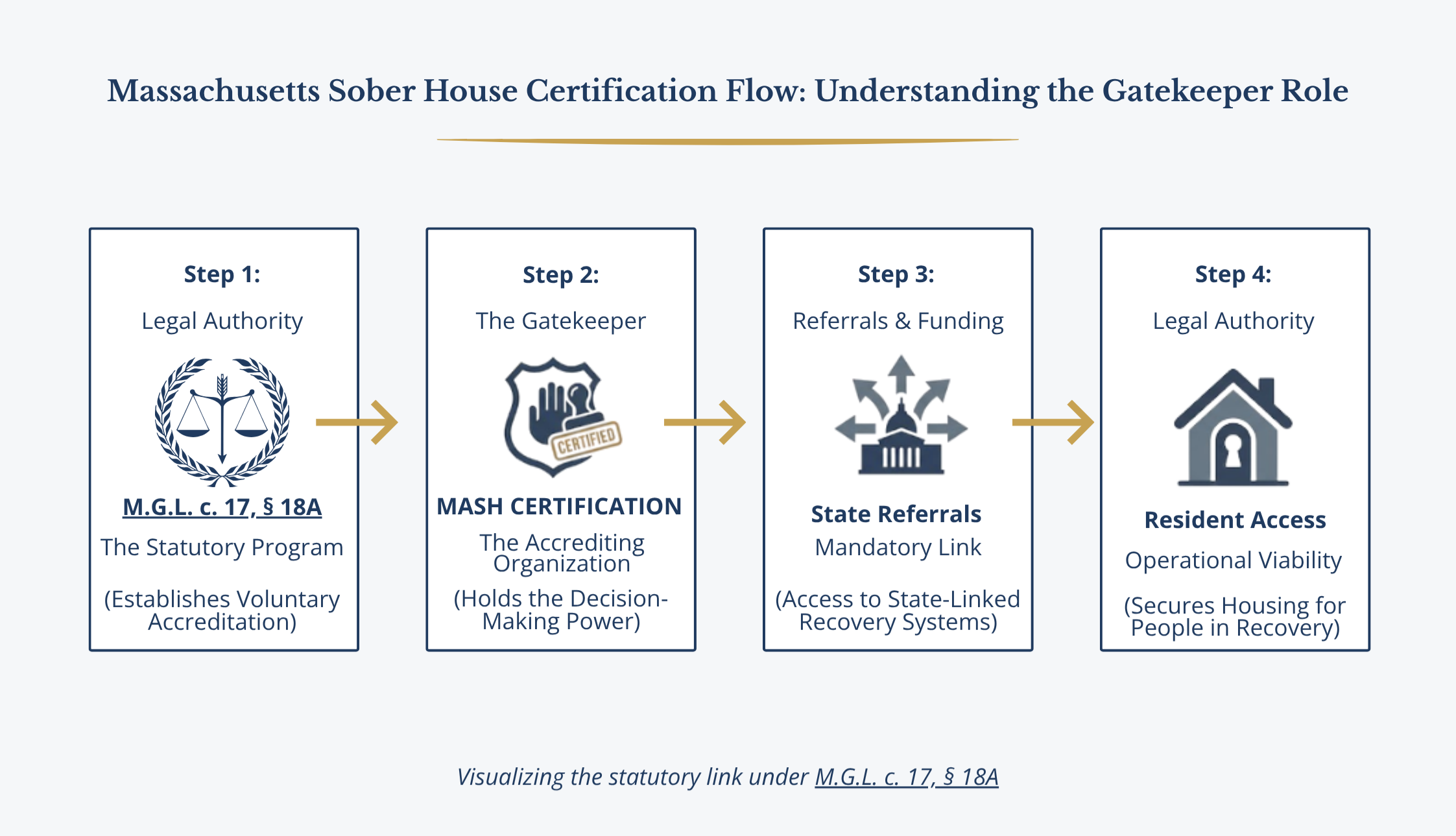
Why MASH Is Being Sued in Suffolk Superior Court
The lawsuit alleges that MASH and its executive leadership helped create and enforce a certification regime that went beyond the statute. According to the complaint summary, Vanderburgh House alleges that Massachusetts required rules and regulations to be promulgated for the certification system, including grievance procedures and standards for excluding homes from the certified list, but that those regulations were not properly adopted while MASH still used extra-statutory standards, discretionary judgments, pauses, denials, and revocations.
The complaint also alleges that MASH conditioned certification decisions on matters unrelated to the statutory certification criteria, including MassHousing sprinkler grant issues and other external concerns, and that a board member with a competing interest opposed certification of a Vanderburgh-affiliated property in Brockton. Those allegations, if proven, would support a broader narrative that the Massachusetts Alliance for Sober Housing was not simply certifying homes, but shaping market access and operator viability through an opaque and potentially unlawful process.
The Problem at the Center of Sober House Certification in Massachusetts

The core issue is not whether sober homes should be held to standards. The issue is whether MASH has been exercising power that belongs to the Commonwealth without the legal structure, transparency, and procedural safeguards that should accompany it. Vanderburgh House’s complaint frames MASH’s role as more than private accreditation; it alleges that MASH was acting “under color of law” because it was performing a state-mandated certification function that directly affected access to state-linked recovery housing systems.
That allegation is especially significant in the context of sober house certification in Massachusetts, where certification status can affect referrals, funding-linked opportunities, and whether a home can realistically compete in the recovery housing market. The statute itself confirms the importance of certification within the state referral system, which is why any defect in how that process is administered has consequences far beyond one operator or one dispute.
MASH, Denise Menzdorf, and the Risk of Contract Fallout
MASH presents itself publicly as the state’s sober housing certifying organization, and its own materials direct operators toward certification, inspections, and the certified residences system. But the pending lawsuit raises a larger strategic question: if the Massachusetts Alliance for Sober Housing is found to have exercised delegated authority improperly, or if the state determines that the certification program has not been administered in a lawful and sustainable way, the Commonwealth may have to reconsider whether MASH should remain in that role at all. That is an inference from the stakes of the litigation and the structure of the program, not an adjudicated fact.
Viewed from that angle, the lawsuit is not just an attack on past decisions. It creates a real possibility that the current model of MASH-led sober house certification in Massachusetts could be destabilized. If the state concludes that corrective action, reform, or replacement is needed, another organization could eventually be positioned to step in as the certifying body. That outcome has not occurred, and I have not located a public source confirming termination of any contract, but the litigation does put that possibility squarely on the table as a matter of policy risk and administrative exposure.
Why the Stakes Go Beyond MASH
This controversy matters because sober home certification is not happening in a vacuum. Recovery housing operators work in a legal environment where people in recovery may qualify as disabled under federal and state law, where homes can function as the equivalent of a family, and where housing providers and their agents are protected from discriminatory barriers. VSL’s legal memoranda emphasize that sober living operators, their agents, and the residents they serve all depend on lawful, consistent systems rather than discretionary gatekeeping untethered from clear legal authority.
That context makes the alleged conduct even more serious. If a certification body controls access to referrals while using standards that were never properly promulgated, inconsistent enforcement, or grievance procedures lacking proper legal foundation, the result is not merely bureaucratic confusion. It can mean lost leases, delayed openings, decertified homes, reduced housing supply, and fewer options for people seeking stable recovery housing. Those are precisely the kinds of harms described in the complaint summary, including alleged lost opportunities in Brockton and Lowell and the alleged decertification-related closure of a home in Marblehead.
Who is Set To Replace MASH and Certify Sober Homes in Massachusetts?
For years, MASH has benefited from being treated as the default authority in sober house certification in Massachusetts. But that status now comes with heightened exposure. The more the lawsuit focuses attention on the gap between what the statute expressly requires and what MASH allegedly enforced in practice, the harder it becomes to defend the status quo.
At the same time, the current moment is creating space for new entrants. Vanderburgh Sober Living (VSL), the nation's largest network of NARR Level II homes, through its combination of operational scale, legal advocacy, and national framework for recovery housing, is increasingly positioned as a viable alternative model. Unlike a purely administrative certifying body, VSL operates directly within the recovery housing ecosystem—supporting operators and actively litigating fair housing and access issues. This dual perspective gives it a practical and legal foundation that aligns closely with the realities of sober housing development.
Conclusion: A New Era for Massachusetts Sober Housing?
The story around MASH, the Massachusetts Alliance for Sober Housing, and sober house certification in Massachusetts is no longer just about standards or best practices. It is now about legal authority, due process, administrative accountability, and whether the current certifying structure can survive sustained scrutiny. The pending Vanderburgh House lawsuit does not prove the allegations, but it does force the issue into the open.
MASH may face more than reputational damage. It could face a future in which its role as the dominant certifying body is questioned, narrowed, or replaced altogether. For operators, advocates, and policymakers across Massachusetts, that possibility is becoming harder to ignore.
For more expert analysis on state regulations and a complete list of legal updates, visit our Legal & Litigation advocacy hub.
FAQ's:
What is the MASH certification process? It is a voluntary program in Massachusetts designed to ensure sober houses meet specific safety and operational standards.
Why is the certification process part of a lawsuit? The lawsuit questions whether the certification standards are being applied fairly and if they create illegal barriers to housing.
Can a sober house operate without MASH certification? While certification is technically voluntary, many state-funded referrals and protections are only available to certified homes, making it a critical business factor.
What should operators do during this legal controversy? Operators should stay informed on the litigation outcomes and ensure their internal policies remain compliant with federal fair housing standards.